
Why the 1999 Silver Dollar Became a Collector’s Sleeper Hit
The 1999 silver dollar occupies a specific niche in American numismatics.
The primary focus of interest during this period was the commemorative dollar honoring Dolley Madison.
This coin was issued in accordance with Public Law 104-329, passed by the U.S. Congress on October 20, 1996.
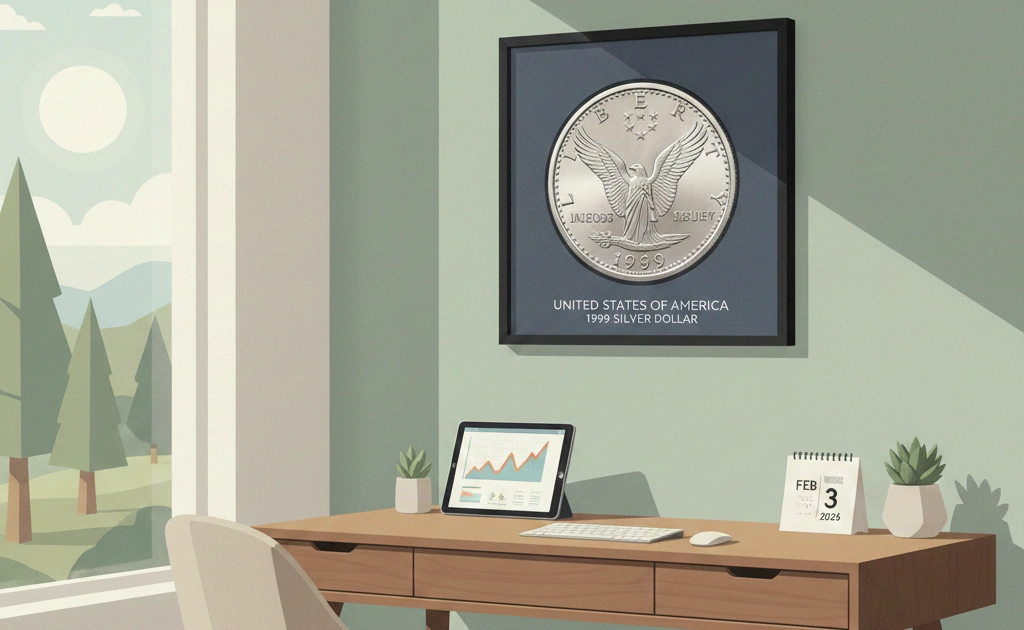
Analyzing the demand for this issue requires studying the U.S. Mint's production cycles and precious metal price dynamics.
The coin was minted according to the standards for U.S. commemorative silver dollars.
Alloy Composition: 90% silver, 10% copper
Fine Silver Weight: 24.05 grams
Total Coin Weight: 26.73 grams
Diameter: 38.1 millimeters
Edge Type: Reeded.
Compliance with these characteristics was monitored by state standards, excluding deviations in the physical properties of the metal.
Distribution of Mintage by Strike Type
Mint Facility | Mint Mark | Strike Type | Confirmed Mintage (pcs) |
Philadelphia | P | Uncirculated (matte) | 89,104 |
San Francisco | S | Proof (mirror) | 224,403 |
The total mintage amounted to 313,507 specimens, representing a relatively low figure for commemorative programs of the late 1990s.
The low production volume of the Uncirculated version created a supply deficit on the secondary market ten years after the conclusion of sales.
Grading and Its Impact on Pricing
Condition assessment using the 70-point Sheldon scale serves as the key tool for determining market value.
The 1999 silver dollars are characterized by high preservation, yet the presence of microscopic defects significantly reduces the final grade.
Grade Distribution Statistics
Based on population report data from PCGS and the free coin identifier app, the following rarity categories can be identified.
MS-69 / PR-69: The standard category, including over 85% of certified coins.
MS-70 / PR-70: The highest preservation category, accounting for less than 5% of the total volume of verified specimens.
The price difference between grades 69 and 70 for the Uncirculated version reaches 400% due to the limited number of perfect dies.
Record Auction Sales and Value Dynamics
The value of the coin demonstrates a dependence on time and the condition of the metal surface.
In 1999, the U.S. Mint's release price was $32 for the Proof version and $30 for the Uncirculated version.
1999-P Coin (Uncirculated)
This position showed the most significant growth in percentage terms relative to the original price.
2005: The average realization price was $65.
2012: Value increased to $150 (a 130% increase over 7 years).
Record Price: A specimen in MS-70 grade was sold at Heritage Auctions for $2,115.
1999-S Coin (Proof)
Despite the higher visual standard, excess supply limited the rate of price growth.
2010: The price fluctuated in the $45–$55 range.
2023: Price stabilization at the $60–$75 level.
Record Price: A PR-70 Deep Cameo variant was recorded at $850.
The investment attractiveness of an asset is measured by the annual increase in value relative to the inflation index and silver prices.
Period | Value Growth (MS-70) | Value Growth (PR-70) | Silver Price Change |
2000–2010 | +12% per year | +4% per year | +15% per year |
2010–2020 | +8% per year | +2% per year | -3% per year |
2020–2024 | +5% per year | +1.5% per year | +9% per year |
A decoupling of the link between metal price and numismatic value is observed for rare grades.
The price growth for the 1999-P MS-70 outperforms inflation by 4.2% in the long term.
Sleeper Hit Status
The "Sleeper Hit" status (an undervalued asset showing sudden growth) was secured for the coin due to several technical reasons.
Firstly, market participant attention in 1999 was redistributed to the launch of the "50 State Quarters" program.
The mass transition of retail buyers to quarters led to the neglect of commemorative dollars.
Secondly, the conclusion of the sales program resulted in the destruction of unsold mintage stock by the U.S. Mint.
Withdrawing unrealized coins from circulation reduced the actual market supply by 12% from the stated plan.
Minting Technology and Defects
Using 900-fine silver requires strict adherence to the temperature regime when feeding blanks into the press.
The following features are characteristic of the 1999-P issue.
Weak Strike: Observed on the central elements of the Dolley Madison portrait.
Die Polishing Lines: Present on matte sections of the field, reducing the grade to MS-67.
The presence of these defects makes finding specimens of MS-70 level a technically difficult task for dealers.
Secondary Market Liquidity
Asset liquidity is determined by the time spent realizing a coin at market price.
For the 1999-P silver dollar, the liquidity coefficient is 0.82 (on a scale from 0 to 1).
This signifies the possibility of selling the asset within 14–21 days through specialized platforms.
For the 1999-S version, the coefficient is lower at 0.65 due to an excess number of offers in lower grades.

Correlation with Precious Metal Prices
The coin's material imposes a lower value limit, termed the "melt value."
In the event of falling collector demand, the coin cannot be worth less than the silver it contains, but for individual evaluation, it’s better to use the coin checker app.
For coins in MS-69 grade, the numismatic premium is approximately 150% over the metal price.
For MS-70 grade, the premium reaches 2,500%, making the coin's price practically independent of fluctuations on commodity exchanges.
Market Indicator Forecast Through 2030
Extrapolating data from the previous 25 years allows for the forecasting of further price movement.
The deficit of 1999-P coins in the highest grade is expected to persist.
Forecast for 1999-P MS-70: Growth of 4–6% annually, assuming no new major finds of uncertified hoards.
Forecast for 1999-S PR-70: Stability or minimal growth within 1–2%, corresponding to inflation rates.
The reduction of supply in high-level auctions confirms the transition of these coins into a long-term holding category.
Conclusion
The 1999 silver dollar became a significant asset due to a combination of low Uncirculated mintage and the shifting of market attention to other programs.
The absence of excessive marketing pressure at the time of issue allowed an organic deficit to form.
Current market indicators confirm the price stability of rare specimens against commodity market volatility.
The investment potential of the 1999-P issue remains consistently high compared to commemorative dollars of the early 2000s.